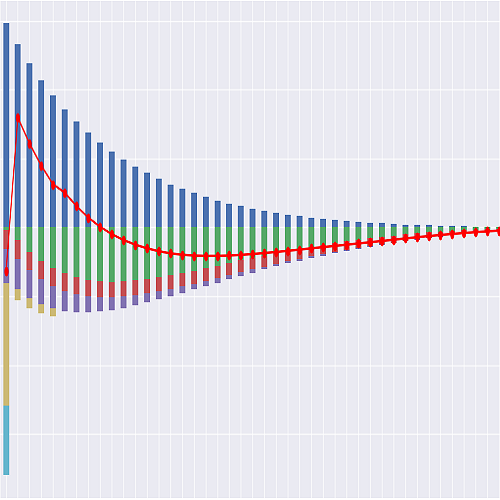
Technical Notes#
Status: Draft, 2026-08-03 (underlying research accessed 2026-08-03).
Scope note: these notes specify a reference liability cash flow projection model
(lifelib/modelx style) for the standardized composite products defined in product-spec.md
(“RefWL-Par” participating whole life; “RefWL-FE” non-par final-expense whole life). They do
not describe any single insurer’s model. [S#]/[R#] tags cite the product research file
(_research/whole-life.md); [REG-R#] tags cite the cross-product reference library
(references/regulatory-and-actuarial-references.md; research provenance in
_research/regulatory-actuarial.md, same R-numbering). std marks standardizations introduced for the
reference implementation. Parameter values are identical to those in product-spec.md.
Model scope and conventions#
Projection frequency: annual, on policy years (anniversary to anniversary) std. Rationale: the contract’s cash flow drivers — level annual premium, annual dividend declaration, anniversary loan-interest capitalization [S1] — are all annual. No monthiversary processing is performed; monthly modal premiums would enter only as a premium-income refinement via modal factors [S1] and are excluded by the annual-mode standardization (product-spec Table 2 note (f)).
Timing conventions std: premiums and premium-linked expenses at the beginning of the policy year (BOY); death claims, dividends, surrenders, and maturity at the end of the policy year (EOY), in the processing order given below. State variables are stored at EOY (= policy anniversary t).
Age basis: age nearest birthday (ANB) std (product-spec Table 1 note (a)); the 2017 CSO set provides ANB tables R8. Attained age at anniversary t is
x + t.Projection horizon: to the anniversary at attained age 100, where the model pays a maturity benefit and terminates std. The contract itself matures at 121 [S1], but the guaranteed CV equals face at 100 and PUA CV equals PUA face at 100 [S1] [S3], so from age 100 the policy is economically an endowment at face; truncating at 100 changes only the timing of the terminal payment between ages 100–121 (mortality vs. maturity), not its amount per survivor.
Model points: single-policy model points, projected seriatim; results scale linearly in face within a band-free specification std. Amounts are U.S. dollars per policy; probabilities are per policy year.
Decrement model: annual rates; deaths before surrenders at EOY; dividends credited to policies in force at EOY before surrender processing std (order list below).
Sex-distinct rates throughout (unisex only as a variant) [S1] [S3].
Model point attributes#
Attribute |
Type |
Example |
|---|---|---|
|
str |
“WLPAR-000001” |
|
enum {WL_PAR, WL_FE_LEVEL, WL_FE_GRADED} |
WL_PAR |
|
enum {TO_100, PAY_10, PAY_20, TO_65} |
TO_100 std (product-spec Table 1 note (b); menu [S1] [S3]) |
|
int |
45 |
|
enum {M, F} |
M |
|
enum {PREF_NT, STD_NT, TOB} std |
STD_NT |
|
float |
100,000 std |
|
float |
1,800.00 [std illustrative] (product-spec Table 2 note (c)) |
|
enum {CASH, REDUCE_PREM, ACCUM, PUA} |
PUA (default [S1] [S2]) |
|
float per year |
0.00 |
|
float (0 = off) |
0.00 (variant: 2 × F std) |
|
float in [0,1] |
0.00 (variant: 0.20 std) |
|
int (0 for new business) |
0 |
|
float (PUA face at t0) |
0.00 |
|
float |
0.00 |
State variables#
Variable |
Meaning |
Initialization |
|---|---|---|
|
Probability in force at anniversary t (per issued policy) |
|
|
Guaranteed cash value per policy (base), EOY t |
table input; |
|
Paid-up additions face in force, EOY t |
|
|
PUA cash value, EOY t |
|
|
Dividend accumulation balance (ACCUM option only) |
0 |
|
Loan balance incl. capitalized interest, EOY t |
|
|
Death benefit payable on death in year t |
formula below |
|
Dividend credited at EOY t |
recursion below |
Assumption inputs#
The model distinguishes three assumption classes. Keeping them in separate input structures is deliberate: (a) is locked by contract, (b) is an insurer-declared snapshot that re-rates annually, (c) is the modeler’s experience basis.
(a) Contractual / guaranteed elements (from the product spec)#
Input |
Value |
Basis |
|---|---|---|
Guarantee interest |
4.00% |
[S1]; Model 808 floor R1 |
Guarantee mortality |
2017 CSO composite, sex-distinct, ANB |
|
Guaranteed CV schedule |
Table input per model point (generated on the above basis) |
[S1] R1; see below |
Gross premium |
Model point input (level, guaranteed) |
[S1] [S3] |
Loan rate |
6.00% fixed, in arrears |
[S1] |
Endowment/maturity |
|
[S1] [S3]; truncation std |
FE premium rates |
Per $1,000 rate table + $36 fee |
[S7] |
FE graded DB |
110% of premiums paid, natural death in years 1–2 |
[S6] [S7] |
(b) Current non-guaranteed scale (insurer-declared; snapshot)#
Input |
Value |
Basis |
|---|---|---|
Dividend interest rate |
6.00% (2026-scale snapshot) |
std, within observed 5.75%–6.60% [S4] [S14] |
Experience mortality in scale |
|
|
Expense margin in scale |
$25 per policy per year |
|
Dividend floor |
|
std (dividends are non-negative distributions of surplus R6) |
PUA purchase basis |
|
std / [S3] (product-spec Table 3 note (k), Riders) |
Accumulation option credit rate |
|
[S2] rate declared annually; reuse of DIR std |
Non-guaranteed scales are constrained in illustration use by the disciplined-current-scale and self-support / lapse-support machinery of Model 582 R2 and ASOP 24 REG-R30; the model’s “current scale” should be interpreted as a currently-payable-scale snapshot, not a projection of future scale changes.
(c) Behavioral / experience assumptions (modeler-set; recommended public bases)#
Input |
Recommended base |
Reference value |
|---|---|---|
Best-estimate mortality |
2015 VBT (sex/smoker-distinct, ANB) × company A/E; industry A/E from the ILEC 2012–2019 study |
tables REG-R18, experience R9/REG-R19; A/E factor 0.70 × 2017 CSO in the worked example [std illustrative] |
Base lapse |
LIMRA/SOA U.S. Individual Life Persistency study (WL by duration/size/mode) |
REG-R20 for the study; rates below std (study figures not recorded in the research file) |
Lapse schedule std |
5.0% year 1, grading linearly to 2.0% at year 10, level 2.0% thereafter; 0 within 1 year of maturity |
std — “low and level” pattern consistent with mature par WL persistency; source study REG-R20 |
Premium persistency |
1 (premiums are fixed and guaranteed; premium cessation = lapse/RPU) |
[S1] [S3]; convention std |
Maintenance expense |
$60 per policy per year, inflating 2.0%/yr |
|
Acquisition expense |
90% of first-year premium + $250 per policy |
|
Premium tax |
2.0% of premium |
|
Loan utilization |
0% base; 20% of CV variant |
All experience values marked std are reference placeholders: no carrier experience data is public in the research base; assumption governance patterns are per the Academy’s PBR Assumptions Resource Manual REG-R25 and ASOP 56 model governance REG-R32.
Cash flow components and recursions#
Notation (defined once, used throughout)#
x           issue age (ANB)                     t   policy year, t = 1 … 100 − x
F           base face amount                    G   gross annual premium
i_g         guaranteed interest (4.00%)         i_d dividend interest rate (6.00%)
i_L         policy loan rate (6.00%)            v_g = 1 / (1 + i_g)
q^g_{y}     2017 CSO rate at attained age y     q^e_{y}  best-estimate rate at age y
w_t         lapse rate in policy year t         l_t  in-force probability at EOY t
CV_t        guaranteed cash value (base), EOY t
NSP_y       net single premium per 1 of paid-up (endow-at-100) WL face at age y,
            on 2017 CSO / 4%:  NSP_y = A_{y:(100−y)|}  (endowment insurance to 100)
ä_{y:n|}    annuity-due, n years, on 2017 CSO / 4%
D_t         dividend credited at EOY t          PUAF_t, PUACV_t  PUA face / cash value
DA_t        dividend accumulation balance       L_t  loan balance at EOY t
DB_t        death benefit for deaths in year t  E_t  expense outgo in year t
Guaranteed cash value: conceptual formula and practical treatment#
Conceptual (Standard Nonforfeiture Law minimum, adjusted-premium / nonforfeiture-net-level- premium method) R1:
NNLP      = F · NSP_x / ä_{x:(100−x)|}                       (net level premium, NF basis)
EA        = 0.01 · F + 1.25 · min(NNLP, 0.04 · F)            (expense allowance)  [R1]
P_adj     such that  P_adj · ä_{x:m|} = F · NSP_x + EA       (m = premium period)  [R1]
CV_t^min  = F · NSP_{x+t} − P_adj · ä_{x+t:(m−t)|}           (t < m; second term 0 for t ≥ m)
on 2017 CSO / 4% [S1] R1 R3. Properties to verify: CV_{100−x}^min = F (since
NSP_100 = 1), and smooth progression by duration R1.
Practical treatment std: the reference implementation reads CV_t (per $1,000 of face)
from a table input, because contractual CV tables are policy-form documents not publicly
available for the surveyed carriers (research gap noted in _research/whole-life.md). The
shipped table is generated from the formula above; an implementer replacing it with a carrier
table changes no other logic. Contractual CV_t ≥ CV_t^min always R1.
Dividend recursion (three-factor contribution formula)#
Anchor (published mechanics of one surveyed carrier) [S4]:
D_t = ( CV_{t−1} + G − MEC_t ) · (1 + i_d) − CV_t
where MEC_t is the mortality-and-expense charge based on actual company results — i.e., the
dividend is the excess of an experience-basis accumulated value over the guaranteed value [S4].
Reference parametrization std (exact carrier factor formulas are proprietary; this is the classic three-factor contribution decomposition consistent with [S4] and the contribution principle R6):
D_t = D^int_t + D^mort_t + D^exp_t ,   floored at 0
D^int_t  = (i_d − i_g) · (CV_{t−1} + NP_g)                       (interest margin)
D^mort_t = (q^g_{x+t−1} − q^{sc}_{x+t−1}) · (F − CV_t)           (mortality margin)
D^exp_t  = e^m_t                                                  (expense margin)
with NP_g = NNLP (the nonforfeiture net level premium, so the interest margin applies to the
guaranteed fund including the year’s net premium) std, q^{sc} the scale’s experience
mortality (class (b)), and e^m_t the per-policy expense margin (class (b)). Dimensions: every
term is dollars per policy per year. Refinements observed in practice — interest on the
mortality margin, premium-timing adjustments, banded factors [S1] [S3] — are absorbed into the
calibration of q^{sc} and e^m_t std.
Dividends on the PUA block (PUAs are dividend-eligible [S14]) std:
D^PUA_t = (i_d − i_g) · PUACV_{t−1} + (q^g_{x+t−1} − q^{sc}_{x+t−1}) · (PUAF_{t−1} − PUACV_{t−1})
No dividend is credited for policy year 1 (D_1 = D^PUA_1 = 0) std (product-spec Table
3 note (j); one carrier pays none [S1], another pays a first-year dividend [S3]).
Direct recognition (loaned values) std parametrization of [S1] [S3]: replace i_d with
i_L on the loaned portion:
D^int_t (adjusted) = (i_d − i_g) · (CV_{t−1} + NP_g − L_{t−1}) + (i_L − i_g) · L_{t−1}
With i_L = 6.00% [S1] and the snapshot i_d = 6.00% std the adjustment is zero — a
coincidence of the snapshot, not a model property.
Dividend application (by option)#
PUA (default [S1] [S2]):
ΔPUAF_t = (D_t + D^PUA_t) / NSP_{x+t};PUAF_t = PUAF_{t−1} + ΔPUAF_t;PUACV_t = PUAF_t · NSP_{x+t}std (valuing all PUA face at the attained-age NSP on the guarantee basis; exact at issue of each layer and at age 100, approximate between std). At age 100,NSP_100 = 1soPUACV = PUAF[S1].CASH: dividend paid out; policyholder cash flow at EOY.
REDUCE_PREM: offsets next year’s BOY premium:
G^{net}_{t+1} = max(G − D_t, 0), excess to PUAs std (excess-to-PUA per one carrier’s reduce-premium option [S3]).ACCUM:
DA_t = DA_{t−1} · (1 + i_d) + D_t; balance adds to death and surrender proceeds [S1] [S2].
PUA rider (in-scope rider)#
Rider payment A_t (BOY, within limits set at issue [S3] [S11]):
ΔPUAF^rider_t = A_t · (1 − 0.10) / NSP_{x+t−1} — 10% load std from the observed
7.5%–10% range [S3]. Rider PUAs merge into PUAF_t.
Term-blend rider (in-scope rider, simplified std)#
Target face TF = 2 F std (within observed caps: ≤ 9× base [S2], ≤ 300% of base [S3]).
Each year, OYT face = max(TF − F − PUAF_t, 0); the dividend first pays the OYT cost
q^{sc}_{x+t} · OYT_t · v_g std, remainder buys PUAs; crossover when PUAF_t ≥ TF − F,
after which the rider is pure PUA [S2] [S3] [S11]. Death benefit while blended: TF + excess PUAs − L_t.
Benefit amounts#
DB_t   = F + PUAF_{t−1} + DA_{t−1} − L_{t−1}                 (PUA/ACCUM components as elected)
CSV_t  = CV_t + PUACV_t + DA_t − L_t                          (surrender value, EOY t)
MAT    = F + PUAF_T + DA_T − L_T   at T = 100 − x             (model maturity [std])
DB per the contractual formula [S1], reduced to modeled components std. Deaths in year
t are assumed to occur at EOY before the year-t dividend is credited, so DB_t carries the
prior year’s PUA face std (terminal-dividend and premium-refund items not modeled,
product-spec Table 3 note (m)).
Annual processing order (policy year t, per unit in force l_{t−1})#
BOY: collect gross premium
G(ift ≤premium period) and PUA rider premiumA_t; pay premium tax and acquisition/maintenance expenseE_t.BOY: apply REDUCE_PREM offset from
D_{t−1}if elected.During year: interest accrues implicitly (CV table on
i_g[S1]; loan ati_L[S1]).EOY — deaths: probability
q^e_{x+t−1}; outgoq^e_{x+t−1} · l_{t−1} · DB_t.EOY — loan interest capitalization:
L_t = L_{t−1} · (1 + i_L)less repayments [S1].EOY — dividend: credit
D_t + D^PUA_tto survivors (from t = 2 std); apply per dividend option; updatePUAF_t, PUACV_t, DA_t.EOY — surrenders: probability
w_tapplied to survivorsl_{t−1} · (1 − q^e_{x+t−1}); outgo= CSV_tper surrendering policy.Update in force:
l_t = l_{t−1} · (1 − q^e_{x+t−1}) · (1 − w_t).At T = 100 − x: pay
MAT · l_T; terminate std.
Ordering (deaths → dividend → surrenders at EOY) is std; it makes surrender values include the just-credited dividend, consistent with anniversary processing.
Net liability cash flow (per issued policy, year t)#
NetCF_t = − G^{net}_t · l_{t−1} − A_t · l_{t−1} + E_t · l_{t−1}          (BOY items, sign: outgo +)
          + q^e · l_{t−1} · DB_t + w_t · l_{t−1}(1 − q^e) · CSV_t        (EOY benefits)
          + D^{cash}_t · l_{t−1}(1 − q^e) + MAT · l_T · 1{t=T}           (cash dividends, maturity)
Internal dividend applications (PUA, ACCUM, REDUCE_PREM) are not cash flows when credited;
they emerge later through DB, CSV, and MAT std. Loans are modeled on the offset
view: see next.
Loans (offset treatment — brief)#
Base run: loan_utilization = 0. Variant std: L_t = 0.20 · CV_t maintained by
borrowing/repaying at EOY; borrowed amounts are policyholder cash outflows from the insurer,
loan interest received is an inflow, and DB/CSV/MAT are net of L_t [S1] [S3] [S9]. Under
direct recognition the dividend adjustment above applies [S1] [S3]. Economically the loan is an
offsetting asset; the reference model reports gross liability flows plus a separate loan
account rather than netting into a “net amount at risk” presentation std.
RefWL-FE variant deltas#
Premium:
G = (F/1000) · rate(x, sex, tobacco) + 36[S7]; no dividends (non-par unverified; modeled non-par).Graded plan: for natural-cause deaths in years 1–2,
DB_t = 1.10 · (cumulative premiums paid); accidental deaths payFfrom day 1 [S6] [S7]. Accidental split requires an accidental-death fraction ofq^estd (reference value 3% of deaths std).Maturity at age 100 (120 in FL — not modeled std) pays
F − L_T[S8].CV schedule: reuse of the par nonforfeiture machinery std (product-spec Table 5 note (r)).
Lapse: FE simplified-issue business lapses higher than par WL; reference schedule 12% year 1, 10% year 2, grading to 6% level by year 5 std (no FE-specific study in the research base; flagged as an open issue).
Policyholder behavior modeling#
Base behavior is static (schedules in class (c)). Dynamic overlays, all std:
Interest-sensitive lapse multiplier (for scenario runs):
w_t^dyn = w_t · min(1 + 2.0 · max(0, r^{cmp}_t − i_d − 0.01), 3.0)wherer^{cmp}_tis the competitor/market rate in the scenario. Rationale: par WL cash values are liquid at book value, so sustained rate spreads induce excess surrender; the low base level reflects the strong persistency of dividend-paying WL. Calibration is judgmental std — the research base records no dynamic-lapse study for WL.Premium offset behavior: once
D_t ≥ G(dividend covers the premium), a fraction0.50std of policyholders switch to REDUCE_PREM/premium-offset behavior (offset is a real product feature: a lettered dividend option at one carrier [S2]; a named automatic offset option at another [S3]). This shifts premium income to internal dividend application in later durations.Loan utilization: static 0%/20% variants only std; no dynamic loan take-up (the 6%-fixed direct-recognition design largely neutralizes loan arbitrage [S1] [S3]).
No dynamic mortality (anti-selection) on lapse for the base par product std; selective-lapse mortality loading is documented mainly for term post-level-period designs (see the SOA persistency/PLT study family around REG-R20), not level-premium par WL.
Worked example#
Single-year walk-through of the core recursion: RefWL-Par, male Standard NT, x = 45,
F = 100,000 std, G = 1,800 [std illustrative], PUA dividend option, no rider, no
loan. Policy year t = 10 (attained age 55 at EOY). All table values are illustrative
std (the shipped CV/NSP tables are generated on 2017 CSO / 4% as specified above);
i_g = 4.00% [S1], i_d = 6.00% std.
Step |
Item |
Formula |
Value |
|---|---|---|---|
1 |
Guaranteed CV, BOY (EOY 9) |
|
9,500.00 std |
2 |
Guaranteed CV, EOY |
|
11,200.00 std |
3 |
Net level premium (NF basis) |
|
1,300.00 std |
4 |
Guarantee mortality, age 54 |
|
0.00320 std |
5 |
Scale mortality, age 54 |
|
0.00224 std |
6 |
Interest margin |
|
216.00 |
7 |
Mortality margin |
|
85.25 |
8 |
Expense margin |
|
25.00 std |
9 |
Dividend |
|
326.25 |
10 |
NSP at age 55 |
|
0.42 std |
11 |
PUA face purchased |
|
776.79 |
12 |
PUA face, EOY (prior 4,100.00 std) |
|
4,876.79 |
13 |
PUA cash value, EOY |
|
2,048.25 |
14 |
Death benefit for year 11 deaths |
|
104,876.79 |
15 |
Surrender value, EOY 10 |
|
13,248.25 |
(For clarity the PUA-block dividend D^PUA_10 is omitted from this table; in the model it
adds (0.02 · PUACV_9) + (0.00096 · (PUAF_9 − PUACV_9)) to the amount in step 9 std.)
Valuation and reserve pointers (brief)#
This library projects gross liability cash flows; statutory, tax, and GAAP measurement are separate layers, cited not reproduced:
Statutory: Standard Valuation Law root REG-R1, codified in the AP&P Manual as Appendix A-820 and now read in full — ¶11 CRVM, ¶¶7–10 the valuation interest rate, ¶16 the aggregate nonforfeiture floor, ¶¶19–20 deficiency reserves, ¶¶24 and 27 the formulaic/PBR boundary REG-R153; A-830 likewise REG-R154, though ¶3.b routes no calculation paragraph to a level-premium level-benefit whole life. Both were “not retrieved” behind the VM-A index entry REG-R110 and no longer are. For issues on/after 2020-01-01 — a date that is the PBR accreditation year, the statutory-law trigger A-820 ¶¶3–4 prints being 1 January 2017 — VM-20 minimum reserve = f(net premium reserve, deterministic reserve, stochastic reserve) with exclusion tests; seriatim NPR on 2017 CSO; traditional par WL typically passes the deterministic exclusion test (valuation net premiums ≤ guaranteed gross premiums) and many WL blocks hold NPR only R3. Small companies under the Life PBR Exemption (< $300M) value under VM-A/VM-C (pre-PBR CRVM) R3. ASOP 52 governs the actuary’s PBR work REG-R31.
Tax: IRC §807 — greater of net surrender value and 92.81% of the CRVM/VM reserve, capped at statutory REG-R16; the statutory engine plus a haircut/cap wrapper.
GAAP: LDTI (ASU 2018-12) rewrites long-duration GAAP (annually updated cash flow assumptions, single-A discounting through OCI) REG-R34 — not fetched; characterization corroborated only by secondary summaries. Same projected cash flows, different measurement overlay — the reason projection and measurement are separated in this library.
Model governance: ASOP 56 (modeling) REG-R32 and, for cash-flow analysis engagements, ASOP 7 REG-R27 — listed in the regulatory bibliography frame validation/documentation expectations for the implementation itself.
Key sensitivities and model risks#
Dominant assumptions (in typical order of impact on par WL liability value):
Dividend scale vs. guarantee spread (
i_d − i_g, mortality margin, expense margin): drives dividends, hence PUA growth, hence death benefit and surrender value trajectories — compounding because PUAs themselves earn dividends [S14]. The DIR snapshot is a declared, changeable rate (observed 5.75%–6.60% for 2026 alone [S4] [S14]); scale-change dynamics are a scenario input, not a model constant.Best-estimate mortality (level and improvement vs. 2015 VBT REG-R18, A/E per ILEC R9): sets both claim outgo and the mortality margin of the dividend; note the same table family feeds two places with opposite signs — a consistency trap.
Lapse: low and level for par WL, but long-duration liabilities are convex in lapse; illustration regulation exists precisely because lapse-supported scales misstate value R2. Verify the model is not inadvertently lapse-supported when testing dividend scales.
Expense inflation on per-policy maintenance for a product with 55+-year horizons.
Loan utilization under direct recognition [S1] [S3]: shifts dividend composition and net cash flow timing; the fixed-6%/DIR-6% snapshot coincidence (zero adjustment) will not survive a scale change.
Known modeling pitfalls:
CV-table vs. first-principles mismatch: if the CV table input and the
NSP/annuity functions come from different bases,PUACV ≠ PUAFat age 100 and the dividend recursion leaks. Regenerate all guarantee-basis quantities from one 2017 CSO / 4% source [S1] R1 R8.Dividend floor and negative margins: with
D_tfloored at 0 std, adverse experience does not claw back — asymmetry matters in stochastic runs.First-dividend timing (year 1 vs 2) shifts early-duration PUA compounding; it is a real cross-carrier difference [S1] [S3], keep it a parameter.
MEC administration on limited-pay variants: 10-pay premiums approach 7-pay limits; face decreases can retroactively create MECs and PUA-rider payments consume 7-pay room R5 [S3] [S1]. The reference model does not police §7702/§7702A limits R4 R5 — flag model points that would fail rather than silently projecting them std.
Truncation at age 100 std is exact for surrender/maturity amounts but reallocates age-100–121 payments from death to maturity; do not use the truncated model for mortality-timing-sensitive measures beyond age 100 [S1].
State variations (FL maturity 120, WA face minimums, ND suicide, MT unisex) [S6] [S7] [S8] [S1] are not modeled; the reference is a generic-state contract std.